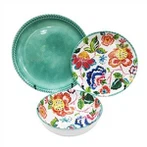
Melamine tableware is a high molecular polymer, the English abbreviation is MF, and its monomers are formaldehyde and melamine. A 37% aqueous solution of formaldehyde is used for the reaction, and the molar ratio of the two monomers of formaldehyde and melamine is 2~3.
Studies have shown that as the amount of formaldehyde increases, the amount of formaldehyde bound increases, and the reaction is easy to proceed; changing the amount of formaldehyde can prepare melamine resins obtained from different methylol melamines. When the pH of the reaction system is 8.5, side reactions will occur. Less, the reaction is easy to control; the temperature is high, the reaction speed is fast, and it has little effect on the amount of formaldehyde in the range of 54~80℃.
In the first step of the reaction, different numbers of N-hydroxymethyl substituents are generated, and then further condensed into a linear resin. Generally speaking, depending on the reaction conditions, the molecular weight of the product is also different, ranging from soluble to hardly soluble in water, and even insoluble solids can be formed. Melamine resin does not cure at room temperature, and generally needs to be thermally cured at 130~150°C. Studies have shown that adding a small amount of acid as a catalyst during curing can increase the curing rate. The cured melamine formaldehyde resin is colorless and transparent, stable in boiling water, and can even be used at a high temperature of 150°C. It has self-extinguishing, arc resistance and good mechanical properties.